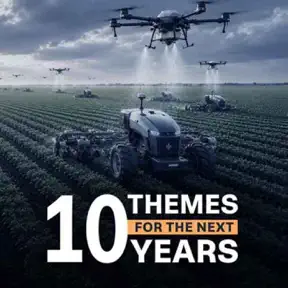
Agriculture: Robots, Drones and the Future of Food | The Decade Ahead
Equity Mates Investing Podcast
August 2, 2026
The world can't create more farmland, but it does need to feed more people. From AI-powered cattle collars and autonomous robots to precision irrigation and gene-edited crops, this episode explores the technologies transforming agriculture.
Speakers Bryce, Ren, Sam Hart, Simon, James Simpson
TopicsInvestingBusinessEducationHow To
Bryce (0:00)
Picture a farm where AI collars track the health of each cow, where drones spray crops from satellite data, and where robots are harvesting fields. This is all real and happening today. Earth can't produce more farmland, so today, we're looking at how we can produce more from the farmland that we have.
Welcome to The Decade Ahead, a series on Equity Mates Investing, where we're looking at 10 themes that we think are set up for the next decade. My name is Bryce.
Ren (0:29)
And I'm Ren. And today, we're talking about the future of agriculture and in particular, the future of agricultural technology.
Bryce (0:37)
This episode of Equity Mates is brought to you by ANZ Business Start Right. Starting a business can come with a lot of what ifs, so ANZ is there to help you with what's next.
Ren (0:47)
Well, Bryce, this is an exciting one. Two soft-handed city boys talking all things farming.
SPEAKER_3 (0:51)
Speak for yourself.
Ren (0:53)
No, to be fair, you are from Wagga, so you know.
Bryce (0:56)
Yeah, from Wagga town.
Ren (0:58)
Yeah, but look, this is a fascinating topic for us. And we're not going to pretend that we know the ins and outs of farming, but what we can see is just the amazing technology that's being developed, and in particular, the amazing technology that's being developed right here in Australia and New Zealand. So we love talking about this. I think over the Equity Mates journey, this has been one of the topics that we've always got pretty excited to talk about.
Bryce (1:22)
Yeah.
Ren (1:22)
So let's get stuck in.
Bryce (1:23)
All right. We'll start with the industry as it is today and then have a look at where it's going to get to over the next decade. Gross value of global agricultural production is $3.5 trillion.
Ren (1:33)
Oh, so pretty big industry.
Bryce (1:35)
Massive.
Ren (1:36)
Agriculture has done well over the years.
Bryce (1:37)
It has done well for many, many years. Some of the largest producers, we've got China. They're the largest annual agricultural producer at $1.65 trillion. Farming accounting for 22% of the entire workforce over in China. India, they have the largest cattle herd on Earth.
Now, you're probably thinking cows. It's actually buffaloes. And agriculture is the primary source of livelihood for roughly 55% of the population of India.
And then the US, they're the leading global exporter in 2025, to the tune of about $170 billion.
Some of their top products, cattle, corn and dairy.
Ren (2:15)
Yeah. So China is the largest producer. The US is still the largest exporter. Yeah. So that's the industry today. $3.5 trillion.
By 2035, it's expected to increase 14% to $4 trillion. Oh, sorry, that's actually 2034 That's the OECD number we could find. Now, that's not a massive growth rate relative to some of the other industries we've discussed like AI and robotics and the like.
The difference is, of course, that the raw number is so big. But gross, it's going to add $500 billion in the next decade. And so, that's why we still think it's worthwhile to talk about. It's also important because of where this development is happening. The Asia Pacific is going to be the hotspot, the emerging middle class we've spoken about in a lot of Southeast Asian nations, but particularly China and India, huge populations. They're going to be both huge producers of food and huge consumers of food. And Australia sits right on their doorstep. So as we get started talking about this topic, it's worth taking a step back and talking about the past sort of 60 years or even longer. Like the whole history of agriculture has been a history of technological innovation, of doing more with less.
And as we've seen, you know, the global agricultural workforce shrink and then the productivity of farmland massively increase as well. And so what we're going to talk about today is a continuation of that story.
But let's start with a bit of history. And let's go back to 1968 with a book that rocked the world. It was called The Population Bomb. And it predicted worldwide famines due to overpopulation and as well as other major societal upheavals and advocated immediate action to limit population growth. And their insight was that food production was growing linearly whilst population was growing exponentially. And that led to a lot of panic. People thought there would be mass starvation in India. It was like this, that way of thinking, that Methuselah way of thinking was a key driver of China's one child policy to try and limit population growth.
Now looking at China's population pyramid, I reckon that one child policy will go down as like one of the cruelest but also dumbest public policy decisions made. But agriculture stepped up and in particular, agricultural technology stepped up between 1960 and 2020 Global agricultural production tripled. Not only did we continue to feed the world's growing population, but we fed them more. Like the last few years, more, at least in the Western world, more people are dying from too much calories than too few calories. That is the story of human ingenuity being applied to this problem. Yes. It's pretty amazing what has resulted. The challenge is we're going to need to do it again.
26 more minutes of transcript below
Thousands of transcripts fetched by people building searchable podcast archives
Fetch the whole transcript
The demo key returns a sample episode in full, no card needed:
curl -H "x-api-key: pt_demo" \
  https://spoken.md/transcripts/1000651996090
Markdown with the speakers named, for your notes, your knowledge base, or anything that makes HTTP calls.
From $0.10 per transcript. No subscription. Credits never expire. Prices exclude VAT, added at checkout for EU customers. Not what you expected? Email us within 14 days with 20 or fewer credits used and we refund the pack in full.
Using your own key:
curl -H "x-api-key: YOUR_KEY" \
  https://spoken.md/transcripts/1000779565236