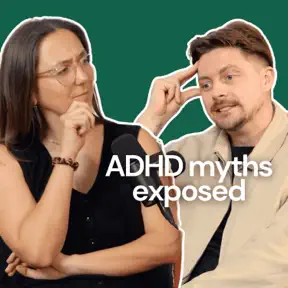
ADHD: Can You Trust What You See on Social Media? | Pt 3
Figuring It Out
November 4, 2026
How much of what we see about ADHD on social media is actually true? And are some of the most common beliefs about ADHD backed by science?
Dr Alex George
Hello, and welcome to part three of the Figuring It Out podcast. We have been talking about ADHD a lot in this one, and particularly with impulsivity, and then a part two, food noise and even substances and so on. So now we're going to move on to the section where we do our myth, fact, and it's complicated. So we look at some of the statements or beliefs out there, and discuss which category it falls into. Should we get started?
Dr Kathryn Bates
Yes.
Dr Alex George
What's our first one?
Dr Kathryn Bates
You shouldn't believe everything you see about ADHD on social media.
Dr Alex George
Aha, can I do this one? That's definitely a fact. Yeah, I mean, I know you've got a study for this, which you'll share in a second, but I think there's so much stuff that's shared about ADHD online. And unfortunately, some of the stuff can be quite A, confusing, but some of it's not even necessarily factual. And I think probably it's about being careful, like, who is sharing this information? Are they someone who has trusted on this kind of topic? And are they trying to sell you something? Three kind of probably good things to kind of look at. But it's also in other ways as well. It's like, I also think you'll be very careful when you listen to even like the media. Like we've seen all the stuff recently. I mean, it doesn't surprise me because I've been in this kind of field long enough, but this whole huge study came out and there's so many big things and they had a focus on like how we're under supporting people with ADHD, that we need to improve services and all these things. And the headline is that there's a risk of overdiagnosing autism.
So the way that sometimes the media will present things isn't always as they should be. So I think being curious and being cautious is important to when you see stuff, particularly about topics like this.
Dr Kathryn Bates
Yeah, I think always try and like look into it in a bit more detail, like go to a podcast or there's, you know, there's different websites like ADHD UK and that have a lot of information that's useful. There's also, I was listening to a podcast called ADHD Babes, which is created with and for women and non-binary people with ADHD.
And one of their guests said that they likely discovered that they had ADHD through seeing things on social media. But they were like, please only use it to open a door, like nothing more than that. Like, because then you can easily get swept into, like, you know, like those videos that are like, do you do this? Do you do that? Do you do this?
Dr Alex George
Oh, you have ADHD.
Dr Kathryn Bates
But they're just random things. Like they don't.
Dr Alex George
Yeah. I think like this, the beauty of socials is, and hopefully you can feel seen by things. And it poses a question. And that question should then lead to an action, which is you go into trusted support. So if you see something like, I wonder about that, then going to the ADHD UK is a great start. And when you start reading the NHS website, ADHD UK, the foundation and so on, looking at these pages, if that then makes you think, oh gosh, I really might have ADHD, then it's looking for a provider that you trust to provide to do that. Go and see your GP, see what the waiting list is like on the NHS, get yourself on that waiting list if you want to be assessed.
I agree, I think social media can be great for that, but if you're relying on it for all your health advice, it's not good. Actually, at Clickbait Clinic, some of the research the BBC did found that a third of people now get their health advice purely online. On social media, it's like for one in three people, it's like that is where they get all of their health information.
Dr Kathryn Bates
That is a lot.
Dr Alex George
Kind of a lot.
Dr Kathryn Bates
I would say to add to that, I think we think as well in research that we do quite a good job at explaining our research in a non-academic way or being able to create clear public house messages. Doing the research for this podcast over the last few months, I don't think we do that very well.
Dr Alex George
The Lancet is not that exciting for the average reader on the underground, the Northern line.
Read the other 23 minutes of this episode here.
$15 gets you this episode and 99 more. Credits never expire. After checkout, one link brings you back here to read it.
Not what you expected? Full refund within 14 days.
Thousands of transcripts fetched by people building searchable podcast archives
Fetch transcripts with code
The same credits work from a script or an AI agent. The demo key returns a sample episode in full, no card needed:
curl -H "x-api-key: pt_demo" \
  https://spoken.md/transcripts/1000651996090
Markdown with the speakers named, for your notes, your knowledge base, or anything that makes HTTP calls.
From $0.10 per transcript. No subscription. Credits never expire. Prices exclude VAT, added at checkout for EU customers. Not what you expected? Email us within 14 days with 20 or fewer credits used and we refund the pack in full.
Using your own key:
curl -H "x-api-key: YOUR_KEY" \
  https://spoken.md/transcripts/1000799713670