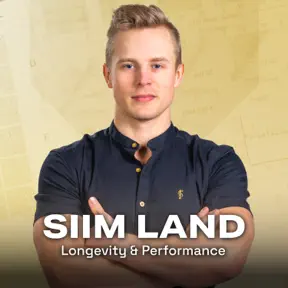
#445 Longevity Supplements Ranked by Doctor Sandra Kaufmann
Siim Land Podcast
March 21, 2025
00:23 Dr Sandra’s 7 Tenets of Aging03:20 Rating system for supplements05:00 Astaxanthin07:50 NAD boosters11:15 Bon Charge Ad12:05 Glycine15:30 Curcumin18:50 Ginger and GLP122:25 Melatonin24:30 Carnosine30:15 AKG35:20 Taurine39:05 Disappointing supplements39:50 Resveratrol43:40 Multivitamin46:10...
Speakers Sandra Kaufmann, Siim Land
TopicsHealth & Fitness
Sandra Kaufmann (0:00)
If you give your mitochondria everything they need to function normally, and taurine is a boost, you're going to eat through those lipids, and you're going to reduce your dyslipidemia significantly. Astaxanthin. And the number of human studies, and the number of things that we have learned about it has just skyrocketed. And I used to think it was amazing, and now it's like uber amazing.
Siim Land (0:23)
Dr. Sandra, welcome back to the show.
Sandra Kaufmann (0:25)
It is a pleasure to be here, thanks for having me.
Siim Land (0:27)
We decided to talk about supplements this time, which is a very popular topic as well. And you've talked a lot about different supplements and with your own rating system for grading their effectiveness or potential for health. So maybe we can just start of giving an overview of what does that system look like and how does it work?
Sandra Kaufmann (0:53)
No, so absolutely. So it starts out with the idea, and I may sound repetitive here, but I will repeat myself. I believe in what I call the seven tenets of aging. And this is how I sort of organize cellular dysfunction. And then the numerical rating system is based on how well supplements or adjuvants do within those categories. So sort of in a moderately small nutshell, tenet one has to do with DNA alterations. So this is epigenetics, this is telomere shortening, and then recently I have added sort of a topic, a subtopic of heterochromatin distribution. Because at the age, our chromatin, the heterochromatin versus eukromatin populations sort of change. And the less heterochromatin you have, sort of the worse off you are. So that's sort of like new and different as the years have progressed. Tenet two is mitochondrial failure. And I think your mitochondria age in about seven-ish different ways depending on how you count them. And this is anything from failure of your mitochondrial transport chain with all the different subunits, sort of coming and going with NAD deficiency, with mitochondrial permeability transition, poor failure, so two and three deficiency. You know, there's some issues with fission, infusion, and mitochondrial biogenesis, sort of, etc. So that's two. Three is pathways.
And here are the classic seven sirtuin pathways, AMP kinase, of course mTOR. And what I've also added in this category of late is the idea that circadian rhythms should be in the pathway category. And this is because there are very distinct molecular mechanisms as to why you sleep and why you wake up. They fail as you get older, we can address them, so therefore I should put that in this category. Tenant four remains quality control. That is DNA repair mechanisms, proteostasis, and of course, autophagy. Five is your immune system that becomes your inflammatory system over time. Six is individual cell needs, which has to do with keeping your stem cells nice and happy, eradicating your senescent cells, and the idea that a red cell is different than a brain cell, etc. And then the last category is waste management, which is mostly glycation issues as well as lipofusion accumulation. So again, in a medium-sized nutshell, that's how I consider aging. And the way the rating system works is that if an agent has evidence in these categories, it gets either a 0, 1, 2, or 3 There's evidence that it does absolutely nothing, it gets a If there's evidence in test tubes or cultures, it gets a 1 Evidence in non-human mammal models, which are usually rodents, it gets a 2
Solid evidence in humans, then it gets a 3 Since all of my agents have a 3-digit writing number, it tells you exactly what they do and what we know.
Siim Land (3:52)
So the best, most powerful magic pill would be that it has 3 in all 7 of the tenets.
Sandra Kaufmann (3:58)
That would be miraculous. And some of them actually, there are some things that get kind of close.
Siim Land (4:05)
What are some examples of this?
Sandra Kaufmann (4:07)
Well, so, for example, metformin does a lot. I think that people have overdone it with dosage, and then you start seeing unfortunate side effects in terms of hippocampal turnover. But metformin is extremely powerful. NAD precursors don't do something in every category, but they do a lot in several categories. They're very potent. And the other thing that we're realizing is that it's, I can't give threes to research that hasn't been done yet. So for agents that don't have a lot of financial backing, human studies are very expensive. So just because we don't know that it does something in humans, we can sort of extrapolate that it probably does. So example, phycetin gets twos in almost every category, but it doesn't have any good threes yet because we just haven't looked. But I think that ultimately a lot of these numbers will go up.
49 more minutes of transcript below
Thousands of transcripts fetched by people building searchable podcast archives
Fetch the whole transcript
The demo key returns a sample episode in full, no card needed:
curl -H "x-api-key: pt_demo" \
  https://spoken.md/transcripts/1000651996090
Markdown with the speakers named, for your notes, your knowledge base, or anything that makes HTTP calls.
From $0.10 per transcript. No subscription. Credits never expire. Prices exclude VAT, added at checkout for EU customers. Not what you expected? Email us within 14 days with 20 or fewer credits used and we refund the pack in full.
Using your own key:
curl -H "x-api-key: YOUR_KEY" \
  https://spoken.md/transcripts/1000700282573