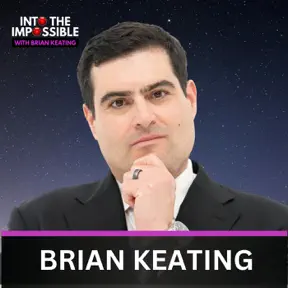
400K Subscribers Asked Me Anything. The Answers Got Weird.
Into the Impossible With Brian Keating
July 11, 2026
400,000 of you showed up for physics with no compromises, so I did something different for the milestone. No highlight reel. I took your hardest questions live and answered them, then got honest about the part of this job nobody asks about: the discipline behind running a serious science podcast.
Speakers Brian Keating
TopicsNatural SciencesSciencePhysics
SPEAKER_1 (0:01)
This episode is brought to you by Google Chrome. You think you know a browser, but Gemini and Chrome, that's new. It can help you with practically anything on the web, like restoring a vintage motorcycle from a 50-page restoration block, or finally break down that long article you've had open for weeks. Gemini and Chrome is here for it. Ready to make anything online make sense? There's no place like Chrome. Check responses set up required, for compatibility and availability, various 18 plus.
SPEAKER_2 (0:26)
This episode is brought to you by Google Health. Stop chasing someone else's definition of health. What matters is what's healthy for you. Google Health offers a new kind of coach, built with Gemini for effortless tracking, sleep insights and holistic coaching tailored to you. Visit googlestore.com to learn more and start a new relationship with your health. Requires Google account, Google Health app, Internet and Google Health premium subscription. Features subject to change, availability and results vary, not intended for medical purposes, works independently of Gemini apps. Check responses for accuracy.
Brian Keating (0:55)
Okay, welcome to the Into the Impossible podcast, a very special episode featuring my favorite guest, me, Brian Keating, celebrating 400,000 of you multiversal minds that traverse the cosmos from consciousness to astrobiology there and back.
When I started the podcast, I assumed that maybe a few dozen nerds would somehow watch, but we built a community that hundreds of thousands of people are listening to or watching. Over 500K when you include the audio versions, which I hope that you will also enjoy. Whether we're talking about inflation or artificial intelligence or aliens or black holes, I think that you're getting something here that you get nowhere else and that's access to the greatest minds in the universe. Some deep dives, I never pull punches, I never hold back. And I just love the fact that I get to do this all. And most of what I provide to you is kind of a hobby. I don't do this for the money. I certainly don't make money on the podcast. And it's just been such a delight. So you'll hear this in the second half. I'm going to answer some questions that were dropped on YouTube and you can join my YouTube channel, Dr. Brian Keating, or my secondary YouTube channel where I do these deep dive explainers into the hottest topics in physics and astronomy, cosmology, artificial intelligence. Those are solo episodes. I do some debunking episodes now called Keating's Razors, and I also do a lot of very fascinating, as I said, solo deep dives on things ranging from negative mass neutrinos all the way up to the solution to the Fermi paradox that I am thinking about working on myself in my other spare time for my side hustle. I need a side hustle. So that other channel is called Keating Experiments. You can find that link below as well. Okay, let's get on to some of the questions. Let's go, 400K Austin Howell, thank you so much. I'm so glad you're part of the multiverse of minds. And then next question, number two. Juan Del Salgado asks, has time ticked at the same pace since the early universe? No, so this is subtle. In general relativity, time can depend on gravity. Gravity depends on matter. And matter in motion also can affect the space time metric. So the universe is much hotter and denser than it was in the early universe than it was now. So an atom in the early universe wouldn't actually notice this because clocks tick locally in the same rate that they do for us in the locally low gravitational environment. Now it is true clocks do tick slightly slower for us nearer to the center of the earth than for an astronaut orbiting on the International Space Station.
But locally, that's a small effect. And so locally Einstein realized, and it's part of his equivalence principle, that you could basically make a freely falling reference frame where anything would perceive the same space-time dynamics as if there were no gravity. So flat space-time is the local approximation, just like a flat earth is a local approximation for any infinitesimal patch of a highly curved surface, whether it's positively curved or negatively curved, where that curvature is coming, you know, built into the universe or from large gravitational fields or distortion. So an atom in the early universe would notice anything. And redshift is not caused by time itself changing, it's caused by the spatial expansion of the universe that stretches wavelength of light, and these waves of light as they travel. So this would not change things. So there's a distinction between gravitational time dilation, which is the slowing and changing of clock rates, which is a true effect that's also responsible for corrections made to the GPS satellite that you and I use to get around in our, using our phones or our cars' GPS. So that's different from cosmological redshift, which stretches light because the universe is expanding. So they're related, but they're not identical. Great question. Okay, at merge form, is every location the center of the Big Bang? Yes, this is a very good way to think about it. If every part of the universe is the center of the universe, then no part is the center of the universe. It's like, where's the center of the surface of the Earth? There is no center of the surface of the Earth, so all points are equivalent. So the Big Bang was not an explosion into space, it was the expansion of space itself. So we often use these analogies. None of them are perfect because we're three-dimensional beings trying to visualize a four-dimensional universe making two-dimensional analogies that I'm about to make, which is a classic one of a balloon that has dots printed on it in the shape of galaxies, if you like. And if you blow that balloon up, it's expanding into the room, so that makes it a little bit less good of an analogy. But every dot would see every other dot moving away. And I can insert here a visualization that I made, redshift and the wavelength distortion that occurs due to the expanding of spacetime. And each galaxy sees every other galaxy moving away from it. In three dimensions, you could have a raisin bread that has raisins inside it. You're cooking it, it's expanding. Every raisin is moving away from every other raisin. So each raisin could say, hey, I'm the center of the bread. But of course, if an infinite raisin bread, it's not possible for any of them to be the center. They're all the center, therefore none of them are the center. So the observable universe does appear to be homogeneous. That means it's sort of the same in every place in the universe, and isotropic, and then it looks the same on large enough scales. So every observer can legitimately consider themselves to be the center of the observable expansion. And these are things we talk about in the Cosmic Office Hours once a month, which I really look forward to. I hear incredible theories, and it's a much cheaper alternative. You know, to the $1,000 for the first hour, and then $2,000, then $4,000, $8,000, et cetera, that I charge for private consultations. I'm more than willing to do that. That money goes to a local food bank at UCSD's campus. It's a 501C3 charity. There's a couple of them here on campus that I will donate that money to. And we've had many people take me up on that level. But this is sort of the level of the conversation that we have on the public office hour, shall we say, or the group office hour that we hold every month. So do join if you're interested. It's $19.99 a month. It's cheap compared to the thousands of dollars that other people will pay. And that my students pay in tuition, quite frankly. And a lot of them don't come to office hours.
111 more minutes of transcript below
Thousands of transcripts fetched by people building searchable podcast archives
Fetch the whole transcript
The demo key returns a sample episode in full, no card needed:
curl -H "x-api-key: pt_demo" \
  https://spoken.md/transcripts/1000651996090
Markdown with the speakers named, for your notes, your knowledge base, or anything that makes HTTP calls.
From $0.10 per transcript. No subscription. Credits never expire. Prices exclude VAT, added at checkout for EU customers. Not what you expected? Email us within 14 days with 20 or fewer credits used and we refund the pack in full.
Using your own key:
curl -H "x-api-key: YOUR_KEY" \
  https://spoken.md/transcripts/1000776368900