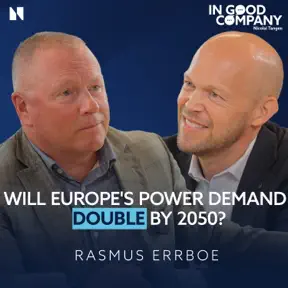
Ørsted CEO: Offshore Wind's Boom and Bust, America's Pushback and Rebuilding Trust
In Good Company with Nicolai Tangen
August 19, 2026
Nicolai Tangen sits down with Rasmus Errboe, CEO of Ørsted, the world's largest offshore wind company, to discuss the company's evolution from a Danish oil and gas business into a pure-play renewables leader.
Speakers Rasmus Errboe, Nicolai Tangen
TopicsBusiness
Rasmus Errboe (0:01)
And then I get a phone call from our general counsel that I have worked with for a decade. And to be honest, I look at the phone and then I actually put it down again, because he had called me.
Nicolai Tangen (0:16)
But he rang again.
Rasmus Errboe (0:17)
Yeah, exactly. Then he sent me a text and said, Rasmus, you should probably just give me a call. And then within less than 10 minutes, we received what is called a stop work order, which is effectively a one-pager that orders you to stop the construction of a project in the US that at the time was 80 percent done. That was pretty extreme, unexpected.
Hi, everybody.
Nicolai Tangen (0:58)
I'm Nicolai Tangen, the CEO of the Norwegian Sovereign Wealth Fund. And today I'm joined live from Oslo by Rasmus Errboe, the CEO of Ørsted, the largest offshore wind company in the world. Ørsted used to be a Danish oil and gas company, sold its fossil fuel business and rebuilt itself around offshore wind. Warm welcome, Rasmus.
Rasmus Errboe (1:17)
Thank you very much, Nicolai. I'm very happy to be here.
Nicolai Tangen (1:20)
Now, just tell me about the start. So like 35 years ago, you built some turbines off the Danish coast.
Rasmus Errboe (1:26)
Yeah.
Nicolai Tangen (1:27)
How come?
Rasmus Errboe (1:28)
Yeah.
So first of all, I've been with the company for 14 years or so, so I cannot take credit, obviously, for the entire journey. But you are right that roughly 35 years ago, the first offshore wind turbine in the world was set up in Denmark in a place called Vindeby.
Nicolai Tangen (1:45)
And why did an oil and gas company start to build wind turbines?
Rasmus Errboe (1:49)
Ørsted is basically founded as a merger, if you will, in 2006 So this happened, this was only part of the company back in the days. But what happened from 2006 and onwards was that that was the start of this journey from being a fossil-intensive company into becoming the global leader of offshore wind today. So that is really where the transformation started.
Nicolai Tangen (2:18)
But it took a long time before wind power generally took off, right? Why was that technology so expensive for such a long time? Yeah.
Rasmus Errboe (2:27)
Even today, offshore wind is still, in many ways, you can say a niche industry, if you look at it in the totality of the energy system in Europe. I think there is today 38 gigawatts or something installed in Europe, so of course it takes time when you build up an industry, but especially from the years from 2015 to 2020, those were years where we were really starting to see the sort of the invasion and industrialization starting to happen and also costs starting to come down.
Nicolai Tangen (2:57)
How come Denmark became the kind of superpower here, which you were until China took over, but you were very big and very dominant, both as an operator but also in terms of constructing these turbines?
Rasmus Errboe (3:08)
I think it's a combination of several things. I think what is important for an industry like ours is sort of predictability and the ability to sort of think long-term, both politically but also from an industry perspective. So I think all the way from the beginning, Denmark has had that sort of commitment and foresight to offshore wind.
It is a relatively sort of stable political environment, the framework, there has been bumps on the road clearly, but the framework has been relatively robust for decades. And then also the industry was sort of ready for it. We are sort of a country with coasts and you have Vestas today, you have Ørsted today. So there was this sort of glooming industry ready to work with the government.
Nicolai Tangen (3:57)
Well, I mean, you got a coast, but so does Norway, right?
Rasmus Errboe (4:00)
You do, for sure.
Nicolai Tangen (4:02)
A long one and a lot of wind.
Rasmus Errboe (4:03)
Yes.
Nicolai Tangen (4:03)
And so when you look at Norway, what are your reflections when it comes to wind power?
Rasmus Errboe (4:12)
If you look at it, sort of, if you lift it up, just one notch and just look at Europe, which is our sort of the core region for us. There is no doubt that there is a massive potential for offshore wind in Europe. We can talk much more about that. I think if you look at it, here in Norway, the challenge has a little bit sort of been to get it off to a good start.
As an example, the seabed is relatively there, sort of, the depth is relatively significant most places. So it's very much floating, and floating is still early days. So you kind of need that sort of standardized approach to also bottom fixed offshore wind in Norway and in many other countries.
36 more minutes of transcript below
Thousands of transcripts fetched by people building searchable podcast archives
Fetch the whole transcript
The demo key returns a sample episode in full, no card needed:
curl -H "x-api-key: pt_demo" \
  https://spoken.md/transcripts/1000651996090
Markdown with the speakers named, for your notes, your knowledge base, or anything that makes HTTP calls.
From $0.10 per transcript. No subscription. Credits never expire. Prices exclude VAT, added at checkout for EU customers. Not what you expected? Email us within 14 days with 20 or fewer credits used and we refund the pack in full.
Using your own key:
curl -H "x-api-key: YOUR_KEY" \
  https://spoken.md/transcripts/1000784211967