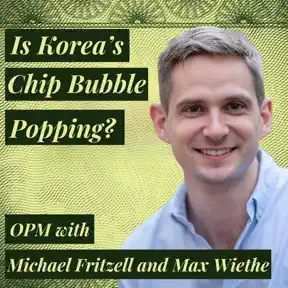
The AI Chip Bubble: Why South Korea & Taiwan Are In the Danger Zone | Michael Fritzell | Asian Century Stocks
Monetary Matters with Jack Farley
June 6, 2026
In this episode of Other People’s Money, host Max Wiethe sits down with Michael Fritzell, author of Asian Century Stocks, to break down the massive valuation divergence playing out across Asian equity markets.
Speakers Michael Fritzell, Max Wiethe
TopicsInvestingBusinessNewsBusiness News
Michael Fritzell (0:00)
South Korea, I do think it is a bubble, because the estimates for Ford profits for SK Hynix and Samsung Electronics, we're now talking 200 billion US dollars in net profit estimates for 2028
That will make them the most profitable companies in the world. These are companies that produce commodities. I wouldn't say that the memory chip cycle is over. In fact, I'm not able to confidently predict how the cycle is going to move, but I'm also very, very confident that these Chinese competitors that have been trying to improve their yields, they are now very profitable and they will come with new supply in 2027 onwards.
Max Wiethe (0:42)
Welcome to Other People's Money. My name is Max Wiethe. I am joined today by Michael Fritzell, the author of Asian Century Stocks that, as its name suggests, focuses on equity research in Asian companies. Michael, thank you for coming. It's an absolutely fascinating time to be looking at Asian stocks with indexes representing countries like South Korea and Taiwan soaring, while the countries like China and India that have long been cited as the de facto leaders in Asia are some of the worst performing markets in the world. Just incredible dispersion in outcomes, at least at the index level in the continent or in the region of Asia. But I want to start there. Why are we seeing such great dispersion in Asian stock returns right now?
Michael Fritzell (1:30)
I have been investing in Asia now for almost 20 years. Through that process, I've seen cycles come and go. What's so good about the geography is that it's a huge breadth of companies and regions. It's huge in terms of what you can invest in. So Asia Pacific is 4 billion people, if you include the Middle East, and includes countries like India and China. Each of them have something like 5,000 stocks. And I'm based in Southeast Asia and another 500 million people. And what's good about the opportunity to set as an investor is, I can choose which country I invest in, and they're not always synchronized.
So I can tell you, from a top-down point of view, we have gone through different cycles. In China seems to have a bull market every three or four years.
And right now, in the past one year, one and a half years, the AI theme has really just taken over everything. And the focus of attention and speculation, everything is on AI stocks. Bottleneck stocks in Japan or the memory chip stocks in South Korea. Even the like the Intel Supply Chain in Malaysia and Singapore, that's what everyone is focusing on right now. So it's almost unbelievable.
The speed at which the indices in Korea have gone up. I don't know how much is up year on year, but it's going to have tripled at least the cost be.
So that's happening and cost be is now 50-60% to memory chip stocks. And I'm noticing also people in Korea are incredibly enthusiastic about these stocks. It almost reminds me a little bit of the 1999 bubble in the US where you had a very few number of popular growth companies and people are selling value stocks in Korea and doubling up on these memory chip stocks. So I feel like we're now, I wouldn't say Asia Pacific is particularly speculative as a whole. There are plenty of cheap companies, but these parts of the market, I have not seen such speculation since 2021, the COVID boom. That was also a period of extreme speculation in South Korea.
Max Wiethe (4:00)
Well, I know you have opinions about the index construction in Asia, but it's really the best thing we have as a measurement for these markets. And you are correct, the EWI, which I like because you can do total return and it's in dollars, the EWI, iShares, MSCI, Korea ETF is up 255 percent over one year, and Taiwan is up a measly 112 percent over that same period of time. So naturally, you're comparing to 2021, you're comparing to 99, 2000 Would you call that a bubble?
Michael Fritzell (4:42)
I think it is because specifically South Korea, I do think it is a bubble because the estimates for Ford profits for SK Hynix and Samsung Electronics, we're now talking 200 billion US dollars in net profit estimates for 2028
200 billion and 250 billion, that will make them the most profitable companies in the world. And these are companies that produce commodities. So I wouldn't say that the memory chip cycle is over. In fact, I'm not able to confidently predict how the cycle is going to move. But I'm also very, very confident that these Chinese competitors that have been trying to improve their yields, they are now very profitable and they will come with new supply in 2027 onwards. So it does not seem like there's any real like longer term constraints. It's just a question of how long is the lead time until we get a supply response. So for me, this will be extremely speculative to enter cheap company, commodity companies at 10 times book or whatever they are right now. It does not seem prudent at all.
45 more minutes of transcript below
Thousands of transcripts fetched by people building searchable podcast archives
Fetch the whole transcript
The demo key returns a sample episode in full, no card needed:
curl -H "x-api-key: pt_demo" \
  https://spoken.md/transcripts/1000651996090
Markdown with the speakers named, for your notes, your knowledge base, or anything that makes HTTP calls.
From $0.10 per transcript. No subscription. Credits never expire. Prices exclude VAT, added at checkout for EU customers. Not what you expected? Email us within 14 days with 20 or fewer credits used and we refund the pack in full.
Using your own key:
curl -H "x-api-key: YOUR_KEY" \
  https://spoken.md/transcripts/1000771467546