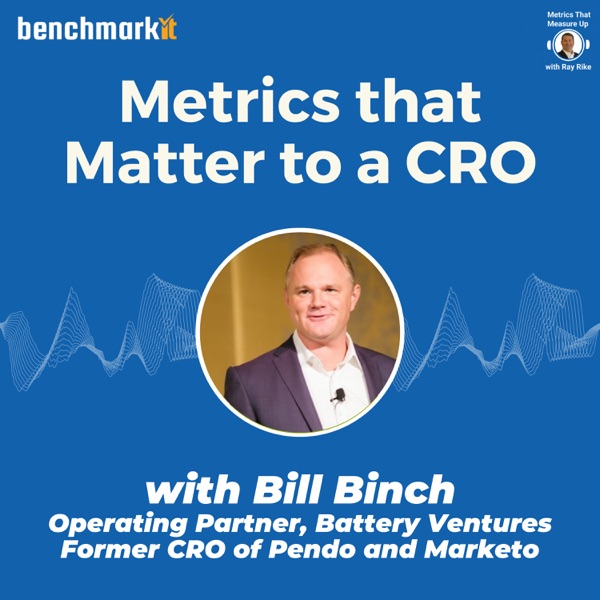
Metrics that Matter to a CRO - with Bill Binch, Operating Partner at Battery Ventures
AI to ROI
October 17, 2022
Topics: Management, Business, Technology
**Ray Rike** (0:00)
Hello, I'm Ray Reich, founder and CEO of RevOp Squared, and your host of the Metrics that Measure Up podcast. We talked to a wide variety of B2B, SaaS and Cloud thought leaders, executives, investors, and people just like you to discuss the metrics and benchmarks they use to make metrics and form decisions. Now on to today's show.
Welcome to today's episode of the Metrics That Measure Up podcast. Today, we are joined by Bill Binch, operating partner at Battery ventures, former chief revenue officer at Pendo, and the initial senior vice president of global sales at Marketo. Today, we'll be covering three main topics with Bill. Number one, the role of metrics for a chief revenue officer. Second, the top metrics that really matter to a CRO. And third, a little more detail on lagging versus leading indicators. Bill, please take a moment to give a brief overview of your journey to becoming a guest on the Metrics that Measure Up podcast.

**Bill Binch** (1:13)
Yeah, you bet, Ray. Thanks for having me join you and the podcast. I'm always excited to talk about this topic, and I think it's become really much more relevant in the last several years. I think the use of data and high metrics has really grown in its usage among sales leaders. But stepping back, I'm a 29-year software sales vet. The last 28 of those were all in software companies. The first half of that was big billion-dollar companies, where I like to say I got my training, I got frameworks, I got foundations. Then I made the leap like a lot of us do into trying my hand at small software companies. The first one I joined was a company that failed and made me really question whether the small business startup world was fit for me.
Then the second one I went to was this magical journey called Marketo that I joined and stayed on with for nearly 10 years. I went from a couple of hundred thousand dollars in ARR through taking it public and then eventually selling it to a private equity firm. Just an incredible journey and ride of seeing a bunch of stages of startup world. Then I used that experience to go to another early stage startup, a company called Pendo, which was a really great, great run, a really fast three-year, very similar look and feel to Marketo on its growth rate. The commonality that both of those companies had is they both were invested in by a firm called Battery ventures. Over a decade or so, I formed a really good relationship with the Battery team. As I came out of Pendo and was debating what was going to be next for me from a career perspective, the idea of me joining the organization as an operating partner, a little different than the general partner. Our general partners have a checkbook and go find the investments and sell the value, what Battery does to their portfolio. For me, I come in when those investments have been made and help the portfolios go through their growth stages and think about and anticipate how they're going to scale.

**Ray Rike** (3:12)
Great. Well, I think we're so fortunate to have you on the Metrics of Measure Up. The reason I say that is I was at Sastra event a couple of weeks ago. Bill, your session on Metrics for Sierra at Sastra was standing room only. It warmed my heart and I'm like, wow, I know that Metrics are really important now because they're standing room only at Sastra to see you speak. Let's step back, open the aperture a little bit on this perspective, and allow you to describe the role of Metrics and our CRO success.

**Bill Binch** (3:44)
Yeah. As I mentioned in my first comments there, I've been in the software biz for 30 years and watching it go from this, kind of what I call, lead from the gut, shoot from the hip way of making decisions around the sales world, to evolving to something being much more data-centric. I mean, it started at first with data and it was all on SQL, but SQL, you need to have skills to access it, so it was hard. But it seems like in the last five, maybe 10 years, there's been a number of biz tools, productivity tools that have come out that have erased that gap that you needed to be technical to be able to go get data. And I think it's making sales leaders today, marketing leaders today, much stronger in their role. They can measure the efficacy of their business so much greater now, which is kind of ironic because if you think about all the functions inside of an organization, sales is normally the most metric, the most black and white, like you made quota, you missed quota, whereas other functions are harder to give an estimate of what level of success they're having. sales has always been that way, but the ability for the sales leader is improving so much more on being able to measure the inputs that go into what's going to yield the outputs of the results that they actually deliver.
27 more minutes of transcript below
Thousands of transcripts fetched by people building searchable podcast archives
Try it now — copy, paste, done:
curl -H "x-api-key: pt_demo" \
  https://spoken.md/transcripts/1000651996090
Works with Claude, ChatGPT, Cursor, and any agent that makes HTTP calls.
From $0.10 per transcript. No subscription. Credits never expire. Prices exclude VAT, added at checkout for EU customers. Not what you expected? Email us within 14 days with 20 or fewer credits used and we refund the pack in full.
Using your own key:
curl -H "x-api-key: YOUR_KEY" \
  https://spoken.md/transcripts/YOUR_EPISODE_ID