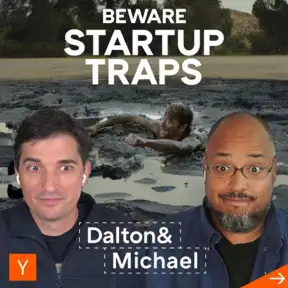
Avoid These Tempting Startup Ideas
Y Combinator Startup Podcast
December 1, 2022
Thinking of a new startup idea? Dalton Caldwell and Michael Seibel discuss the types of ideas to stay away from—what we commonly refer to as "tarpit ideas." Apply to Y Combinator:
Speakers Dalton Caldwell, Michael Seibel
TopicsTechnology
Dalton Caldwell (0:00)
That's the tar pit talking. It's like, oh, this looks like a nice pool of water. No one's here drinking at it. I'm going to go get a drink of water from this pool, right? Like, no, danger, quicksand.
Michael Seibel (0:16)
This is Michael Seibel with Dalton Caldwell, and today we're going to give advice on pivoting by discussing the startup ideas that founders most often pivot into and away from. We call these ideas Tarpid ideas.
Dalton, explain the problem here. What's going on?
Dalton Caldwell (0:38)
So here's the deal.
It's surprisingly... A lot of people's ideas are surprisingly the same across founders. And so when we read the thousands of applications that apply every batch and we interview the thousands of companies every batch that we do, there's a lot of common ideas.
And specifically what we're going to be talking about today is Tarpid ideas. I won't explain what that means in a moment. But these are ideas that lots of people try and they don't succeed and they don't pivot back out of them quickly enough. So it's a cause of death for many, many, many, many companies statistically are some of these Tarpid ideas. So I'll put this back to you, Michael. Explain why we would use the word Tarpid. What are we trying to say? What does that mean? I know you did some research here.
Michael Seibel (1:28)
Yeah, did a little bit of Google in here. So a Tarpid is a place where petroleum is kind of coming up and seeping up through the earth. And it tends to be a great place to find fossilized remains, dinosaurs, other forms of life. And the reason why is that apparently tar pit pools resemble freshwater ponds.
And so animals will come across them, think it's freshwater, step in, get stuck because the tar is very sticky, die, start to decompose, that smell will attract more animals, and then you get this kind of cascading negative effect, which, as I say it out loud, describes the phenomenon in the startup world so perfectly, it's not even funny.
Dalton Caldwell (2:20)
Yeah, tar pit ideas attract founders to them, and they seem like good ideas, they seem like something people want. It's ideas that are very appealing, and the fact that there isn't already famous companies solving them already attracts more founders.
You see what I'm saying? It looks like you've come up with this amazing original idea, and the death of everyone that attempted it is hard to see, and all you see is like a freshwater pool. You're like, oh, this is a wide open space for us to solve.
Michael Seibel (2:53)
But right below the surface.
Dalton Caldwell (2:56)
Yeah, it looks good, right? That's why it's so alluring. And so look, why are we doing this talk, or why are we telling you this?
We would love for this not to happen to you. We would love to not see the tens of thousands of applications of people working on these really rough ideas. And if you can manage to not fall into the tar pit yourself, your overall odds of success in your startup journey are much higher. That's why we're talking about this stuff.
Michael Seibel (3:26)
Well, let's be clear.
Not only do these companies apply and do we interview them, we have funded many tar pit ideas. So we've seen the journey from founders in YC, and them getting stuck in this space too. So a lot of what we do at YC is we try to communicate the common paths of failure, so you don't follow them. And this is just another example of that.
Dalton Caldwell (3:49)
Let's start. So let's begin with this.
The fact is, most tar pit ideas, at least the ones we see the most and the ones we're talking about today, are what you would call consumer ideas.
Consumer means the customer is a consumer. We'll talk about that in a second, but let's dive into that. Michael, why don't you kick this off? What is a consumer idea? What is a consumer business?
Michael Seibel (4:13)
So this is a product that's being marketed to people, not companies. Sometimes these products are free and monetized with ads. Social networks are extremely common. Sometimes these products are paid products. You know, the whole gig economy I would describe as a consumer business. But you know it's a consumer business because individual people use it, and it's a product that's not primarily marketed to businesses.
That's where you know you're in the consumer world.
Dalton Caldwell (4:44)
Yeah, and there's some nuance here, folks, on the internet, so we don't need to get into a semantic debate. We're just trying to just go with us on this definition. Just bear with us here, even if there's some nuance to debate about this.
21 more minutes of transcript below
Thousands of transcripts fetched by people building searchable podcast archives
Fetch the whole transcript
The demo key returns a sample episode in full, no card needed:
curl -H "x-api-key: pt_demo" \
  https://spoken.md/transcripts/1000651996090
Markdown with the speakers named, for your notes, your knowledge base, or anything that makes HTTP calls.
From $0.10 per transcript. No subscription. Credits never expire. Prices exclude VAT, added at checkout for EU customers. Not what you expected? Email us within 14 days with 20 or fewer credits used and we refund the pack in full.
Using your own key:
curl -H "x-api-key: YOUR_KEY" \
  https://spoken.md/transcripts/1000588351055