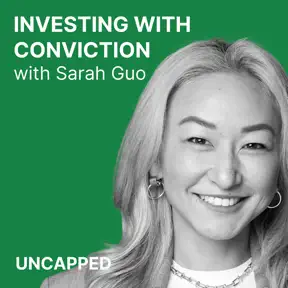
Uncapped #5 | Sarah Guo from Conviction
Uncapped with Jack Altman
April 3, 2025
I was pumped to chat this week with Sarah Guo. Sarah is a startup investor and the founder of Conviction, an investment firm purpose-built to serve intelligent software, or "Software 3.0" companies.
Speakers Jack Altman, Sarah Guo
TopicsTechnology
Jack Altman (0:01)
All right, Sarah, thank you for doing this. I realize that you've been spending more time being the interviewer than being interviewed, but I appreciate you doing this, and it's nice to be doing it in your office.
Sarah Guo (0:10)
Yeah. Well, any excuse to hang out with you.
Jack Altman (0:11)
The first thing I want to ask you about is, what a VC firm is. And the thing I've been thinking about a bunch is, when I was doing Lattice, I knew what a company was. You build a product, you sell the product. There's a very tractable thing. And then over the last year doing venture, full time for the first time, it struck me that it's a much more sort of flimsy concept. And there's obviously a fund that owns shares, but then there's a brand and there's people and there's these other parts. And as I've been thinking about building a VC firm, I've realized that thinking about what it actually is is sort of like a wispy idea. And so I would love just to hear from you as you've thought about, you've been at one, like a very substantial, long standing one. Now you've built your own. How do you think about what a VC firm is?
Sarah Guo (0:59)
We've taken like two steps toward building our own.
Jack Altman (1:02)
You've done something, though.
Sarah Guo (1:03)
It's an interesting question. Like the way we think of it internally is, and it's not like the most flattering view, but venture is a bundle of like money. I'm thinking about the value prop to the customer, right? The customer is the founder. Venture is a bundle of money where like everybody's money is approximately green, right? You can have like lower and higher quality LPs, but generally that's not how founders make their decision. Then you have people and beliefs that you are associated with as a founder. And then you have advantage, right? Like, what can, like, can... And I wouldn't do the job if I didn't figure, like, that the last piece could matter at all. But help you can give companies and to try to make things happen faster or make ideas, like, more possible to actually make real.
It is a weird way to think about venture as a business, because for all tech investors love to talk about, like, motes and differentiation and sustainable advantage. I think venture, like, when you think about those components, money is the purest commodity. The rest of it is pretty squishy. It's a lot of, like, brand and individuals that feel quite fragile or, like, point in time. But, you know, some of the great venture brands, they've been around for a long time, and I think it's still possible to build an enduring institution. So.
Jack Altman (2:27)
Yeah, and some of those brands do, something is compounding there. And I guess maybe that's an interesting sort of way to pull on the thread is, like, what is compounding at Sequoia or Greylock, or these firms that have been successful for decades? What's the thing that is, like, hard to knock off balance? Like, what is the thing that's making the, is it, like, is it the brand? Is it the network of founders? Is it something about the way they do business? Like, what is holding on through different years and teams and cycles?
Sarah Guo (2:54)
Yeah, well, I would start by saying, like, I actually, like, really want to try to live like this. And I think your entire, like, personality expresses this. But, like, this is, this doesn't feel like a particularly zero sum environment. I think you can try to build a new thing without saying we're, like, completely after somebody else. But in terms of durability, I think you have, you have, like, ethos, right, like what matters to the people in a firm that goes from generation to generation and different investors. You have, like, some tribal knowledge, and that is, like, what has worked in the last generation of companies. Good and bad biases, like the history of technology, right? Like, here's how Apple or Google or Nvidia did it, or Facebook, for that matter. And then you have, you have brand, which is just obviously what founders think of the place, how much success you've had, and then you have network. And I think those are, I think those are the things that are harder to replicate very quickly.
I think you also, if you are at a platform venture firm, you have a lot of capital available to you, but there's also just a lot of capital in the world.
Jack Altman (3:59)
Yeah, I want to come back to what you said about sort of the whole, the zero sum nature of it all, and to what degree, you know, more value gets created versus, you know, venture capitalists are sort of, are capturing. I've heard some people say that they think that great founders select, like the truly great founders are actually selecting for a different thing than other founders when they're thinking about their VCs. I can't remember, but you know, who all, but one name that comes to mind, I know Parker at Rippling has said that like, brand is the most valuable thing that he can get from a VC because it makes it easier to recruit, easier to get the next customer, et cetera. And like, he's going to do the work anyway. And so at least he can get a brand. Do you think, like, as you've experienced sort of working with companies and founders, do you think that there are different attributes in a venture firm that different founders prioritize and does that impact at all the way that you want to build when you think about, you know, your founder is the customer, but obviously you're looking for certain founders within that customer set.
42 more minutes of transcript below
Thousands of transcripts fetched by people building searchable podcast archives
Fetch the whole transcript
The demo key returns a sample episode in full, no card needed:
curl -H "x-api-key: pt_demo" \
  https://spoken.md/transcripts/1000651996090
Markdown with the speakers named, for your notes, your knowledge base, or anything that makes HTTP calls.
From $0.10 per transcript. No subscription. Credits never expire. Prices exclude VAT, added at checkout for EU customers. Not what you expected? Email us within 14 days with 20 or fewer credits used and we refund the pack in full.
Using your own key:
curl -H "x-api-key: YOUR_KEY" \
  https://spoken.md/transcripts/1000702029007