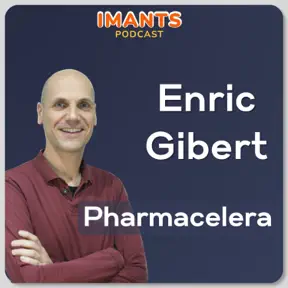
Two Chip Engineers and a Drug Hunter Walk Into a Tapas Bar
Imants Podcast
March 29, 2026
The founding story of Pharmacelera. How two Intel chip designers, a pharma industry veteran, and a quantum mechanics professor built a drug discovery company from scratch.
Speakers Imants Zudans, Enric Gibert
TopicsEntrepreneurshipBusinessScienceLife Sciences
Imants Zudans (0:00)
Welcome to Imants Podcast, where founders powering drug discovery share how they built their companies. My guest today is Enric Gibert, CEO of Pharmacelera. Enric spent a decade designing processors at Intel. Then he started building software for drug hunters. How does a chip engineer end up in medicinal chemistry? That's what we explore today.
Enric, thank you for joining us here today. Maybe let's start your story with Dental.
Enric Gibert (0:37)
Thank you, Imants, for the kind introduction, and thank you for inviting me. It's a pleasure to be here talking today to you and the audience. So, yeah, Intel, so as you mentioned, my background is not chemistry, biology, or any scientific background. I'm a computer engineer. My areas of expertise are high-performance computing, software development, artificial intelligence. I did a PhD in these fields at the University of Polytechnic of Catalonia here in Barcelona, where I live, okay? But during the PhD, I did a research stay at the University of Illinois in Urbana-Champaign in the US., okay? And after doing the PhD, I joined Intel. Intel at that point in time had opened a lab, a research lab in Barcelona, that was very near to the UPC, and it was in fact directed by my PhD advisor, Professor Antonio González. So it was a natural step for me, okay?
I stayed there for 10 years, and what we were doing there was to design the processors, the chips, the hardware accelerators, at a 5, 10 year time frame, okay? So when you need to design what is going to be the microprocessor or the GPU or the hardware accelerator for this time window, 5, 10 years from now, okay? You don't have the hardware, okay? So you need to start doing some sort of simulations and modeling and benchmarking against your current products, and that is what we were doing. Nothing to do with life sciences. We were designing the chips and the hardware accelerators of the future, and the idea was a research lab, but the idea was to impact the product lines of Intel. At the Polytechnic University of Catalonia, there was a big research group on computer architecture. The group had a pretty strong reputation, so Intel decided to open an R&D facility that was like 2002, 2003 The lab began by just eight people, and over 10 years, it reached a peak of 80 people, 60 of them with a PhD. It was like a small research site compared to other sites at Intel. I mean, 60, 80 people were collaborating a lot with the people in Santa Clara, where the headquarters of Intel are. We were also collaborating a lot with the people in Oregon and Israel and Germany.
Imants Zudans (3:08)
That sounds very exciting, very interesting.
Enric Gibert (3:11)
As you say, it sounds a lot of fun. We had a blast. I had the privilege to work with people that were super smart, super inspiring, and that I saw that was extremely important to keep me motivated. My mom always said that while I was at Intel, there was not a single day in which I complained when going to work, okay, because we were having fun.
Imants Zudans (3:38)
Spent a decade at Intel and then it was in 2014 that Intel decided to close Intel Barcelona site, right? What happened?
Enric Gibert (3:51)
One of these unfortunate situations in which a big multinational had promised investors that they would have sales of 50 billion, okay, and they didn't reach that, okay. They got like 49.5 or 49.7. I don't remember, okay. So they felt short with respect to the expectations and then from a management perspective, they decided to start closing like small and mid-size sites. They closed one in Mexico. They closed one in Germany that was more or less the similar size of us, 100 persons, and then they closed ours.
And concentrate and they decided to concentrate all the R&D efforts in bigger sites, okay. Yeah, I mean, that story is a lesson learned because I've seen other companies, like big companies in which they need to reduce head count or they need to do some rework. You start hearing rumors, okay, you start and you spend like six or nine months asking yourself, is it going to be me? I mean, and then to just lower your performance, your engagement, because you don't know how you, your group, your site is going to be affected. Okay, I've seen that happening in other situations. This was the opposite. Okay, and it has pros and cons, but I remember there was a Monday in which the head of the lab in Barcelona was discussing with his boss in Santa Clara the budget for that particular year. Okay, that was on a Monday. Okay, and they were discussing what projects we would be running for that particular year, what was going to be the budget for the entire lab in Barcelona that year. Okay, that was on a Monday. This same boss landed on Wednesday, so 48 hours afterwards to say that the site was closing. Okay, that we were laid off. Okay, so it was like immediate action, okay? No rumors, okay?
38 more minutes of transcript below
Thousands of transcripts fetched by people building searchable podcast archives
Fetch the whole transcript
The demo key returns a sample episode in full, no card needed:
curl -H "x-api-key: pt_demo" \
  https://spoken.md/transcripts/1000651996090
Markdown with the speakers named, for your notes, your knowledge base, or anything that makes HTTP calls.
From $0.10 per transcript. No subscription. Credits never expire. Prices exclude VAT, added at checkout for EU customers. Not what you expected? Email us within 14 days with 20 or fewer credits used and we refund the pack in full.
Using your own key:
curl -H "x-api-key: YOUR_KEY" \
  https://spoken.md/transcripts/1000758046231