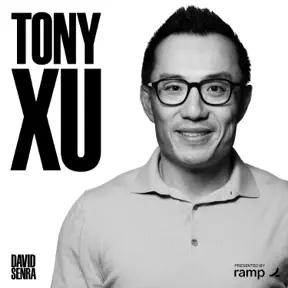
Tony Xu, DoorDash
David Senra
March 29, 2026
Tony Xu is the co-founder and CEO of DoorDash, the largest food delivery platform in the United States. Before he was a tech executive, he was a dishwasher. Xu was born in Nanjing, China, and immigrated to the U.S. at age four with parents who arrived with $200 in the bank.
Speakers David Senra, Tony Xu
TopicsBusiness
David Senra (0:02)
So, I want to start with the fact that you said that Palo Alto delivery.com, which was DoorDash and FortarDash, was the most minimal version of a minimal viable product. Can you explain how you built it?
Tony Xu (0:14)
Well, whenever you can ship something in 43 minutes to test your idea, I think that's pretty good. And certainly this is 12, 13 years before the rise of LLMs and AI tools to make it so easy to do that. But basically the four of us wanted to test this idea that if you wanted to offer delivery from places that never offered delivery before, what is the fastest way to see whether or not consumers would care? I mean, at the end of the day, delivery is not a new idea. And so we thought actually one of the reasons why maybe delivery in 2013 hadn't been around yet was just because nobody wanted it. So we shipped paloaltodelivery.com, that alias was available for $9. And so that's why we got it. Not a super scalable URL, but we were able to get it. It was a static page where you saw eight PDF menus of restaurants that we frequented in Palo Alto. And the only way in which you can order is you can read through the menus, you can call a Google voice number that would ring the cell phones of the four founders, and one of us would pick up. We would take your order, place the order on your behalf, go and get the order, deliver it to you. And I used to be an intern at Square, and so I had these card readers, which was one of their earliest products, these white dongles that could stick into the audio jacks of iPhones, and that's how we would collect payment.
David Senra (1:33)
Something I didn't remember until, because it feels like DoorDash and Uber Eats and everything else has been around forever, but there wasn't, what was the state of, there was other delivery companies, but you essentially created the market for this. Can you explain, like, when I was telling people, I'm really excited, I'm going to go speak Tony for DoorDash, they were like, I can't believe he survived in this competitive market, but they just assumed that all, like, there was other apps out there that were already delivering for restaurants that didn't have a delivery fleet. That didn't exist then.
Tony Xu (2:00)
No, actually, yeah, I think one of the biggest misconceptions when we were founded was just how wide open the space was, where there were about a million restaurants in the states, and maybe 20,000 to 25,000 of them offered deliveries. Most of them were pizza shops, places in New York City, some in, you know, Chicago, some in, you know, big city centers. But outside of pizza places, maybe a few Chinese restaurants, nobody offered delivery. And so the real grand question or experiment of DoorDash, Palo Alto delivery.com was, okay, what about everyone else? What if you can enable everyone to actually offer delivery? What would that take? And first of all, would people care? And that's really why we ship something so quickly, just to see if people would actually come and place orders.
David Senra (2:42)
So what were the existing companies doing then?
Tony Xu (2:44)
They were mostly honestly faxing orders, believe it or not. So they would be a website that would receive orders, if you can believe it. They would fax the orders literally into machines that would sit near the kitchen or the payment systems inside these restaurants. Then the restaurants would actually go out and do the deliveries themselves. So they were lead gen companies at the time.
David Senra (3:05)
I've heard you talk about developing this like last mile logistics network. Did you think about that back then? Or you're just like, hey, I'm just going to try to expand the market for food delivery?
Tony Xu (3:16)
No, we did. So when we started, I guess, to take a step back before we shipped Palo Alto delivery.com, or even how we got there, my co-founders and I really got connected because of an interest in small businesses. I think my story I've told publicly, which is really, I grew up coming to the States as an immigrant from China, and my mom put food on the table by working three jobs a day for 12 years. One of those jobs happened to be at a Chinese restaurant where she was a waitress. I got to hang out with her, wash a few dishes when she allowed me to. That's kind of how I grew up while my dad was getting his PhD at the University of Illinois. That was the first 10 years or so of childhood, growing up in the States. And that moment and experience always just gave me a deep appreciation for what small business owners represent. I mean, to them, there's no such thing as work. Work, life, it's all the same thing. There's no concept of a weekend or a Saturday. It's Saturdays and Tuesdays are exactly the same days. And you just kind of get into this process where that becomes your identity. And it's actually one of the most fascinating things I find about the great experiment that's America, where, you know, because it becomes this all-consuming thing, one of the nice positive derivatives is actually they don't just create great experiences like a restaurant or a bar or a furniture store or a t-shirt shop. They actually create the GDP for all the cities that we live in. That GDP is what allows us to have great neighborhoods, schools, all the positive things that happen from a local community. And that was always my fascination with it. We had no idea, though, when we're looking at starting DoorDash, about anything related to what these business owners' problems were. And so my co-founders and I, we spoke with 300, maybe, businesses up and down the Bay Area from San Jose to San Francisco.
101 more minutes of transcript below
Thousands of transcripts fetched by people building searchable podcast archives
Fetch the whole transcript
The demo key returns a sample episode in full, no card needed:
curl -H "x-api-key: pt_demo" \
  https://spoken.md/transcripts/1000651996090
Markdown with the speakers named, for your notes, your knowledge base, or anything that makes HTTP calls.
From $0.10 per transcript. No subscription. Credits never expire. Prices exclude VAT, added at checkout for EU customers. Not what you expected? Email us within 14 days with 20 or fewer credits used and we refund the pack in full.
Using your own key:
curl -H "x-api-key: YOUR_KEY" \
  https://spoken.md/transcripts/1000758009872