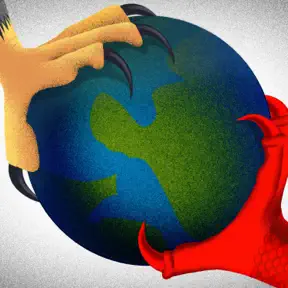
The World After Trump
Foreign Policy Live
March 24, 2026
It’s widely accepted that the post-WWII order has changed, but the question remains—what comes next? Political scientist Hal Brands maps out three possible scenarios in a cover essay for Foreign Policy’s latest print issue and joins FP Live to discuss.
Speakers Ravi Agrawal, Hal Brands
TopicsNews CommentaryNewsPolitics
Ravi Agrawal (0:01)
Hi, I'm Ravi Agrawal, Foreign Policy's Editor-in-Chief. This is FP Live.
So, every week on this show, we talk a lot about the twists and turns in US foreign policy, especially in the Trump era. I wanted to take a big step back today. If you look back at modern history, how has Trump changed the world? I have a few examples to think about. Rules, norms, and institutions are being discarded. The Trans-Atlantic Alliance, a bedrock of the last 80 years in world order, has weakened. More and more countries are talking about seeking nuclear weapons. And the general idea of a US focus on the Western hemisphere opens up the possibility of the other hemisphere being fair game. In a new cover essay for FP's spring print issue, the geopolitical thinker Hal Brands describes what the world after Trump looks like. It might seem premature to go there, but I actually think this is exactly the right time. We need to look at what might come next, if only to better inform what to do now. Brands paints a world in which three scenarios have emerged as possibilities. First, a return to block politics, in which the United States and China jostle for influence. Second, an age of empires, in which several powerful states subjugate their neighbors in smaller countries. And third, a more dangerous world of jungle law, where anything goes and every state is out for itself. It's worth gaming out each of these scenarios, if only to better understand which of them is the best outcome, and how to make sure we get there. I urge you to read Brands' essay, as well as the four other accompanying pieces in our new print issue, which we are gift-linking to in the show notes. But for now, here's Hal Brands. He's a Professor of Global Affairs at the School of Advanced International Studies at the Johns Hopkins University. We taped this earlier in February. Let's dive in. Pal, welcome back to FP Live.
Hal Brands (2:15)
Thank you for having me.
Ravi Agrawal (2:17)
So great essay. Let's begin with an overview of the three scenarios you lay out. What are they?
Hal Brands (2:23)
Sure. So of the three scenarios, the first is the one that in some ways takes us back to the Cold War past. And this is essentially a new Cold War or a two world scenario in which you have a Chinese led block on the one hand doing battle geopolitically and geo-economically with an American led block on the other. And we have to acknowledge that at this point, the American led block is likely to be a bit looser and more transactional than we might have expected even a couple of years ago. But the guiding theme of this scenario is that the US-China rivalry is real. It is here to stay regardless of what happens in symmetry between Xi Jinping and Donald Trump. And it will exert powerful structural pressures on both the US and China and the rest of the actors in the international system, just as the Cold War rivalry between the US and the Soviet Union did. So that's scenario one.
Scenario two is what you might think of as a classic spheres of influence approach. And in this scenario, you have a US that essentially doubles down on dominance of the Western Hemisphere. And in the process, it pulls back from security commitments in Europe, the Middle East, and East Asia. And as it does so, it creates opportunities for other regional powers to pursue their own spheres and their geographical backyards. And so you can imagine a Chinese sphere of influence encompassing large swaths of East Asia and Southeast Asia. You can imagine a Russian sphere of influence encompassing parts of the former Soviet space. You can imagine India striving for greater primacy within South Asia and the Indian Ocean, littoral, and so on and so forth. And so this is a world that is fragmented not into two giant blocks, but into several regional spheres, each of which becomes almost a domain unto itself, even though there is persistent interdependence to some degree between them. And then the third and final scenario is basically an end to the darkness. It is a return to the sort of pervasive global instability that we saw in the opening decades of the 20th century, when you had two world wars in close succession. And the forcing function here is essentially an America that turns increasingly acquisitive and increasingly preditorial. And in that circumstance, the three most powerful countries in the world, the United States, China, and Russia, are all essentially revisionist powers. And they create a sense of self-help among other countries who now have to take desperate measures, whether it's acquiring nuclear weapons or otherwise, to defend themselves. And the result is essentially a spiral downward into chaos. That is a dire scenario, but we can't treat it as being totally out of the question anymore.
29 more minutes of transcript below
Thousands of transcripts fetched by people building searchable podcast archives
Fetch the whole transcript
The demo key returns a sample episode in full, no card needed:
curl -H "x-api-key: pt_demo" \
  https://spoken.md/transcripts/1000651996090
Markdown with the speakers named, for your notes, your knowledge base, or anything that makes HTTP calls.
From $0.10 per transcript. No subscription. Credits never expire. Prices exclude VAT, added at checkout for EU customers. Not what you expected? Email us within 14 days with 20 or fewer credits used and we refund the pack in full.
Using your own key:
curl -H "x-api-key: YOUR_KEY" \
  https://spoken.md/transcripts/1000757090105