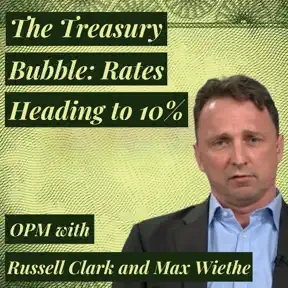
Interest Rates to 10%: Why the Treasury Market is the Real Speculative Bubble (Not AI) | Russell Clark
Monetary Matters with Jack Farley
July 22, 2026
In this episode of Other People's Money, Max Wiethe sits down with hedge fund manager Russell Clark to discuss why he believes the U.S. Treasury market is a much larger and more dangerous speculative bubble than AI.
Speakers Russell Clark, Max Wiethe
TopicsInvestingBusinessNewsBusiness News
Russell Clark (0:00)
If I look at people 40 and under, those in their 20s and 30s, their number one problem is they can't afford housing. If you want to get housing back to some more reasonable levels, you need to have wages rising at about 7% a year, so doubling in 10 years, and then you need to have the housing market be flat in nominal terms, so falling in real terms. So that requires you to have a real rate of about 3%, so people keep their money on deposit rather than stick in to real assets. So that gives you an interest rate around 10%.
And that's still my target for the year Treasury is a 10% yield. So the question you sort of ask yourself is, you know, how far could wages go?
Max Wiethe (0:49)
This episode of Other People's Money is brought to you by the Teucrium Soybean Fund, ticker SOYB. Let's get into it. Welcome to Other People's Money. I'm Max Wiethe and I'm joined today by Russell Clark, a hedge fund manager based in London. Russell, thank you for coming on the show.
Russell Clark (1:04)
Thank you for having me.
Max Wiethe (1:05)
You write a sub stack as well as managing a hedge fund. And I have been reading and following. You put out an interesting piece in the last week.
Looking at the AI trade, a lot of people are saying this might be the end of a big speculative bubble in this AI trade. But you pointed to another asset class that you think is far larger and far more speculative. Tell me why you think this other much bigger market is really where there is a lot of risk right now.
Russell Clark (1:38)
Yeah, so I think Max, you're talking about the Treasury market. There are two questions there. Is the AI market speculative? And why do I think Treasury markets are speculative, if that makes sense? So with the Treasury market, I mean, normally, if you look at, for me, if you look at any big bear trade that I've seen in my investing career and even before it, normally, there were pretty good signs that things are going wrong, but people just happily ignored it, partly because it's human psychology. It's if there's a problem and you have to do something about it, it's always more comfortable just to ignore it. If it hasn't been a problem, that makes sense. That's just natural human psyche. If you go back to the GFC, for example, people knew there was a problem in the housing market three, four years before it actually blew up. Then there started to be a problem and everyone was like, it's a problem, but it's a problem we can deal with before.
Then you had, of course, people saying, well, look, actually, the balance sheets of these banks are so bad that this housing crisis is going to be a bigger problem. Eventually, everyone sort of accepted it. I'd say with US. Treasuries in particular, but government bonds in general is that for last few years, particularly since COVID, there's sort of been this understanding by the electorate and by politicians that governments will spend whatever it takes to keep growth going, if that makes sense. So if there's any problems, government come in. And with the Trump administration, we seem to have gone to another even more extreme version of that, in that we will spend what we need to spend and we won't tax anyone either, in particular, the large corporates. So we just want, you know, we're going to have the spending, but we're not even going to try and get the taxation in. And so if you start looking at, you know, the sort of government, what's the word, profit and loss statement, if you like, you know, its revenue now sort of barely covers its sort of mandated expenses of like social security interest payments and these sort of things. I think we're about 90 percent. So that's excluding other spending like on defense, education, infrastructure, wherever you want. So the fundamentals of the the government's sort of spending taxing, you know, tax and spend have really broken down. And that's not just in the US. It's also in Japan.
And so what's been interesting for me is that, you know, I sort of originally became quite bearish on treasuries in 2022, mainly at that time. There were other reasons, but mainly because when Russian foreign reserves were frozen, so they couldn't access them after they invaded Ukraine, I thought to myself, well, if you have foreign reserves, you know, if you're a Russian government with foreign reserves and suddenly this money you're saving, you can't access, why would you save it in that place in the first place? And then, you know, you take that sort of thinking logic a couple more steps further and you go, well, actually, why would any country that could theoretically disagree with the Trump administration, which is basically everybody, you know, why would anyone hold treasuries as foreign reserves? That makes sense.
50 more minutes of transcript below
Thousands of transcripts fetched by people building searchable podcast archives
Fetch the whole transcript
The demo key returns a sample episode in full, no card needed:
curl -H "x-api-key: pt_demo" \
  https://spoken.md/transcripts/1000651996090
Markdown with the speakers named, for your notes, your knowledge base, or anything that makes HTTP calls.
From $0.10 per transcript. No subscription. Credits never expire. Prices exclude VAT, added at checkout for EU customers. Not what you expected? Email us within 14 days with 20 or fewer credits used and we refund the pack in full.
Using your own key:
curl -H "x-api-key: YOUR_KEY" \
  https://spoken.md/transcripts/1000777893249