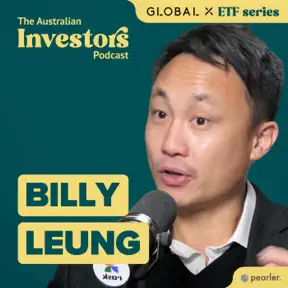
How to build the growth side of your portfolio with Billy Leung from Global X
Australian Investors Podcast
August 18, 2026
In this Australian Investors Podcast episode, Owen Rask sits down with Billy Leung from Global X for episode two of the portfolio construction series, this time focusing on the part of investing that attracts the most attention: growth.
Speakers Billy Leung, Owen Raszkiewicz
TopicsBusiness
SPEAKER_1 (0:00)
When you need to build up your team to handle the growing chaos at work, use Indeed Sponsored Jobs. It gives your job post the boost it needs to be seen and helps reach people with the right skills, certifications, and more. Spend less time searching and more time actually interviewing candidates who check all your boxes. Listeners of this show will get a $75 sponsored job credit at indeed.com/podcast. That's indeed.com/podcast. Terms and conditions apply. Need a hiring hero? This is a job for Indeed Sponsored Jobs.
SPEAKER_2 (0:30)
This episode is brought to you by Accenture. When you're advertising operations fall out of sync, everything else follows. Spotify and Accenture are working together to reinvent the rhythm of ad sales. Using automation, analytics, and smarter workflows to simplify campaign delivery and access better data across the business. The result? Less time spent on operations, more time connecting brands with the moments and fandoms that matter most.
Learn more at accenture.com/spotify.
SPEAKER_3 (1:00)
You know those tiny back to school emergencies that somehow become your problem? That's why I love Uber Eats. You can order school supplies, snacks, and lunchbox essentials for $5 or less. So when your kid casually drops, I don't like peanut butter anymore, or I need five green highlighters for a project due tomorrow. Uber Eats has you covered. Get everything you need for back to school today from your favorite brands like Albion Staples on Uber Eats. Order now.
N's 97, $5 or less before taxes and fees. Select items only. Availability varies. See app for details.
Billy Leung (1:30)
Cisco was a classic name where they were in the right time at the right spot. They were in the internet era. They were one of the best players. It was a structural theme. But if you invested that in around 1999 or 2000, you would have just broke even right now.
And the reason was because the entry level really, really matters. And price earnings ratio is just a number. You can be high, can be low, but it's all relative. You know, essentially, what are you paying for X? And that X, to me, is growth.
Owen Raszkiewicz (1:55)
How do you think about the valuation when you think about growth investments and trying to squeeze the lemon or trying to make more return?
Welcome to episode two of our Portfolio Construction Series. This is probably the most fun part because we're going to be talking about the growth part of your portfolio. How do you build that out? What's reasonable? What's not? We've got Billy Leung, absolute expert in ETFs and growth investing and technology. He's joining us for this episode and at the end, he's going to share some ETF names that you can pop on your watchlist. We've got so many examples to get through, but I have some really good educational questions to put to Billy to help you build your own portfolio properly. Hey there, here's a quick note. This podcast contains general financial advice only. That means it's not specific to you, your needs, goals or objectives. So don't act on the information until you've spoken with your financial advisor. You'll find our full disclosure, disclaimer and link to our financial services guide in the show notes.
Billy, how are you doing?
Billy Leung (2:55)
Good, how are you?
Owen Raszkiewicz (2:56)
Very good, mate. Very good to be talking about growth as an overall thing in a portfolio. Yes. I think this is, if we've got our series, this will be the episode that's most watched because I think that this is the stuff that people really like.
Billy Leung (3:11)
I hope so. I hope so.
Owen Raszkiewicz (3:12)
So no pressure.
Billy Leung (3:13)
Don't let us down, but no pressure.
Owen Raszkiewicz (3:15)
So we're going to talk a little bit about what goes into a growth portfolio, the mechanics of why growth happens. So like how does the growth actually occur? Why does it occur? And what should we be looking at? And then we're going to end with a few ETFs that we can pop on people's watch lists. My first question is, like most people, when they think about growth, they say, I want to achieve a return or something like this. But how does it actually occur? Like when you think about a good portfolio, I guess maybe I framed this the right way, is what does a good portfolio look like in terms of growth assets? And then we'll peel back a layer from that.
Billy Leung (3:51)
Yeah, so I mean, look, this is obviously, we can go very high level and we can go so really deep. I mean, on a high level, looking at a portfolio, which is maybe tilting more towards growth, it's essentially about asset allocation.
26 more minutes of transcript below
Thousands of transcripts fetched by people building searchable podcast archives
Fetch the whole transcript
The demo key returns a sample episode in full, no card needed:
curl -H "x-api-key: pt_demo" \
  https://spoken.md/transcripts/1000651996090
Markdown with the speakers named, for your notes, your knowledge base, or anything that makes HTTP calls.
From $0.10 per transcript. No subscription. Credits never expire. Prices exclude VAT, added at checkout for EU customers. Not what you expected? Email us within 14 days with 20 or fewer credits used and we refund the pack in full.
Using your own key:
curl -H "x-api-key: YOUR_KEY" \
  https://spoken.md/transcripts/1000784170512