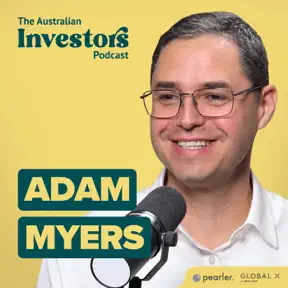
How investors can access private markets in the age of AI, with Adam Myers
Australian Investors Podcast
July 28, 2026
In this Australian Investors Podcast episode, Owen Rask sits down with Adam Myers to unpack one of the biggest shifts in modern investing: more of the value in the world’s best companies is now being created before they ever reach the stock market.
Speakers Adam Myers, Owen Rask
TopicsBusiness
SPEAKER_1 (0:00)
This episode is brought to you by Accenture. When you're advertising operations fall out of sync, everything else follows. Spotify and Accenture are working together to reinvent the rhythm of ad sales. Using automation, analytics, and smarter workflows to simplify campaign delivery and access better data across the business. The result? Less time spent on operations, more time connecting brands with the moments and fandoms that matter most. Learn more at accenture.com/spotify.
SPEAKER_2 (0:30)
Here's your report.
SPEAKER_3 (0:31)
Thanks, Jane. I wish I could hire someone just like you.
SPEAKER_2 (0:34)
Try LinkedIn Hiring Pro. It's more than a job board. It's like the recruiter you always wished you had. Hiring Pro uses real-time insights to match your role to LinkedIn's unique network of professionals and delivers a short list of best fit candidates. You'll spend less time sorting applicants and more time talking to the right people. Let's do it.
SPEAKER_3 (0:51)
You're irreplaceable Jane, but another you would be great.
SPEAKER_2 (0:54)
Hire right the first time. Post your job for free on LinkedIn today at linkedin.com/quality.
SPEAKER_3 (1:01)
This episode is brought to you by Google Chrome. You think you know a browser, but Gemini and Chrome, that's new. It can help you with practically anything on the web, like restoring a vintage motorcycle from a 50-page restoration block, or finally break down that long article you've had open for weeks. Gemini and Chrome is here for it. Ready to make anything online make sense? There's no place like Chrome. Check responses set up require compatibility and availability varies 18 plus.
Adam Myers (1:26)
Private companies, they set the minimum investment amounts at levels that are probably beyond what the average investor is able to commit.
Owen Rask (1:35)
You and the team at Pangana, how do you then practically go and get access to those companies?
Adam Myers (1:40)
Either we'll invest directly into the equity or we will co-invest. We established AIX in order to help bridge that gap, to provide exposure to the unlisted companies at a time in the investment cycle, when there was still a real opportunity for value creation, before they'd be in the pickup that's often associated with the transition to public markets.
Owen Rask (2:05)
Hey there, here's a quick note. This podcast contains general financial advice only. That means it's not specific to you, your needs, goals, or objectives. So don't act on the information until you've spoken with your financial advisor. You'll find our full disclosure, disclaimer, and link to our financial services guide in the show notes.
SpaceX IPO'd for $2 trillion US dollars or thereabouts, which is a lot of Australian dollars. I don't even want to calculate that on the fly. But what it demonstrated to me was that so much of the value of these generational companies, these amazing companies, is actually created before the company gets to the stock market. And unless you work for SpaceX or you work for one of these companies, how can you benefit from that? This is what we call the private market. And today, we're going to talk about that with Adam from Pingana. We're going to talk about how do you actually get exposure to that stuff before everyone else has figured it out on the public market. Now, we're going to go deep into a few companies. We're going to talk about portfolio construction and a few other things as well.
If you like private markets, if you are interested in technology and AI, this is the episode for you. I hope you enjoy it. Adam, welcome to the show.
Adam Myers (3:18)
Thank you. Pleasure to chat to you.
Owen Rask (3:20)
Always a pleasure, mate. We've had you on the show before. It was a cracker of an episode. And today, we're talking about AI, we're talking about technology, we're talking about private markets. This is like perfect. I told you this morning in an email that private markets and AI are probably the two things that everyone wants to talk about right now and our community is really interested in.
I did some quick math before today's show, and SpaceX IPOed for a $2 trillion market cap. It's a lot of money in Australian dollars. It created 4,100 million employees, and 400 of them went on to have a net worth over $100 million.
That's a lot of value, a lot of money being created basically, or at least being realized on day one of this company coming to the stock market. What does that say to you?
Adam Myers (4:12)
Well, firstly, those are amazing stats. It's unbelievable how well they've executed.
What it tells me is how much value is being created in private markets before public market investors have an opportunity to participate in these companies at all. If we think away about how the model used to work, and it wasn't particularly long ago, promising growth companies would come to the stock exchange, would raise public equity, and investors would be able to participate along the journey as they went from promising to potentially industry-leading. Google is a great example. When Google IPOed, it was at a $25 billion valuation. Investors, public market investors got aboard at that stage, and today, it's worth $4.2 trillion. So it's been a great ride for investors. Today, it's changed because there is no shortage of capital available for great companies in the private markets. So founders can attract employees. They can build the businesses according to the long-term vision. They can retain that control without the inconvenience of public market listing, without the short-termism that creeps in when you've got a report on a quarterly basis.
28 more minutes of transcript below
Thousands of transcripts fetched by people building searchable podcast archives
Fetch the whole transcript
The demo key returns a sample episode in full, no card needed:
curl -H "x-api-key: pt_demo" \
  https://spoken.md/transcripts/1000651996090
Markdown with the speakers named, for your notes, your knowledge base, or anything that makes HTTP calls.
From $0.10 per transcript. No subscription. Credits never expire. Prices exclude VAT, added at checkout for EU customers. Not what you expected? Email us within 14 days with 20 or fewer credits used and we refund the pack in full.
Using your own key:
curl -H "x-api-key: YOUR_KEY" \
  https://spoken.md/transcripts/1000778788427