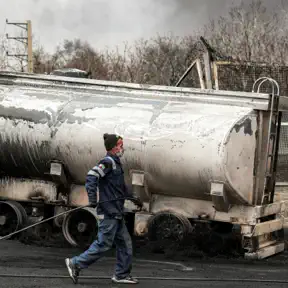
How High Could Oil Prices Go?
Foreign Policy Live
March 26, 2026
Crude and gas prices are soaring after the closure of the Strait of Hormuz and attacks on regional energy infrastructure amid war in the Middle East. How bad could the energy shock get and for how long? FP columnist Jason Bordoff sits down with Ravi Agrawal to discuss.
Speakers Ravi Agrawal, Jason Bordoff
TopicsNews CommentaryNewsPolitics
SPEAKER_1 (0:01)
This episode is brought to you by Nespresso. Introducing Virtuo Up, the latest in a long line of innovation from Nespresso. It's innovation you can touch, sense, and taste in every single cup. With a three-second start, easy open lever, and dedicated brew over ice button, it's even easier to enjoy your coffee your way. Sip for yourself. Shop Virtuo Up exclusively at nespresso.com.
Ravi Agrawal (0:29)
Hi, I'm Ravi Agrawal, Foreign Policy's Editor-in-Chief. This is FP Live.
We are in the greatest global energy security threat in history. Those are the words of Fatih Birol, the head of the International Energy Agency. And that's from last week. With each passing day, as Iran continues to essentially shutter the Strait of Hormuz, global energy prices are continuing to rise. I'm recording this on Thursday, March the 26th. Brent Crude, the main benchmark for oil, is up 78% this year. That's a direct hit on individual pocketbooks. In the United States, the cost of gas at the pump is up by 34% since the war began. Diesel, which powers most freight trucks, is up by 43%. And all of that has an inflationary effect on any good that travels from A to B. Globally, the costs are even higher. In addition to carrying a fifth of crude every day, the Strait of Hormuz also transports a fifth of global LNG, or liquefied natural gas. Qatar, one of the world's biggest suppliers of LNG, saw its Ras La Fan facility hit last week, knocking out 17% of its capacity. So put together, that has led to soaring gas prices in Europe and Asia. And when you add up that impact from crude and natural gas, you'll see why Pakistan has shut down universities and moved classes online. Laos has cut the number of school days from five to three. The Philippines has declared a state of national emergency. This could get a lot worse before it gets better. So I wanted to bring on an expert today to ask, how bad could this get? How long will it stay bad? My guest this week is Jason Bordoff, an FP columnist, and the founding director of the Center on Global Energy Policy at Columbia University. Bordoff served in the Obama administration as a senior director on energy and climate in the National Security Council. One more thing, a personal note, I became a father a few weeks ago. It is awesome, profound, and wonderful, all the cliches. You may have noticed we had a couple of episodes that were a little bit off the news. Well, they were pre-recorded, and I'm back now, but I will be off here and there over the summer. We're going to keep the show running, but I wanted to let you know we might have the odd pre-taped show here and there, and it's for the best possible reason. Thank you for following along and for being such a great audience. Let's dive in.
Jason, welcome to FP Live.
Jason Bordoff (3:22)
Thank you so much. It's so good to be here.
Ravi Agrawal (3:24)
It's great to have you on. I'm going to start with a very basic question. Iran has effectively shut down the Strait of Hormuz. Why is this one passageway so important for energy?
Jason Bordoff (3:35)
Well, as you said in your opening, which captured the situation well, it's by far the most critical choke point for global energy flows. 20% of the world's oil, 20% of the world's liquefied natural gas. That's not the full amount that's been disrupted because there were some workarounds that we have figured out, but still there's no real workaround or policy intervention that can cope with the loss of 20% of the world's supply. And so this is both in total volumes and in percentage terms as a percent of global consumption, the largest disruption in energy supply we have ever seen.
Ravi Agrawal (4:10)
And of course, a lot of the ships, for example, that are carrying crude, the ones that were out of the Strait of Hormuz before the war began are just reaching their destinations in Asia. And so a lot of the ships that are stuck right now, we haven't even seen the full effects of them being stuck and not reaching their destinations.
Jason Bordoff (4:31)
No, that's right. So as you said, you noted in the opening how much energy prices have risen. It is still worth observing that Brent today, as we're talking, is about $107 a barrel. That's not that high. I mean, it's high relatively speaking, but closing the Strait of Hormuz, war in the Middle East, missiles flying across Gulf oil producing countries has been sort of the mother of all nightmare scenarios that energy security policy wonks like myself have scenario planned around for decades. And these are the scenarios with $200 oil prices. So it is quite striking that oil is only at the level, even though it's quite a bit higher than earlier in the year, as you said. And there are a couple of reasons for that. One is what you said, at a certain point, the physical reality of the market catches up to the traded price of oil, which also reflects investor expectations.
34 more minutes of transcript below
Thousands of transcripts fetched by people building searchable podcast archives
Fetch the whole transcript
The demo key returns a sample episode in full, no card needed:
curl -H "x-api-key: pt_demo" \
  https://spoken.md/transcripts/1000651996090
Markdown with the speakers named, for your notes, your knowledge base, or anything that makes HTTP calls.
From $0.10 per transcript. No subscription. Credits never expire. Prices exclude VAT, added at checkout for EU customers. Not what you expected? Email us within 14 days with 20 or fewer credits used and we refund the pack in full.
Using your own key:
curl -H "x-api-key: YOUR_KEY" \
  https://spoken.md/transcripts/1000757597015