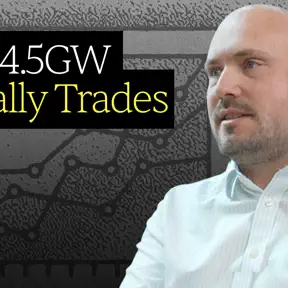
How Battery Traders Actually Make Money - Statkraft
Transmission
June 9, 2026
Most battery revenue projections stop at the day-ahead auction.
Speakers Ed Porter, Brian Lonn
TopicsInvestingBusinessSciencePhysics
Ed Porter (0:00)
I'm your host, Ed Porter. Welcome back to Transmission.
People think the secret to making money from a battery is predicting the price. It isn't. Ask where the value is, and you'll hear forecasting. But that's not everything. The real edge is positioning an asset, so it profits whichever way prices move. Brian Lonn is head of flexibility at Statkraft, which runs around 4.5 gigawatts of flexible capacity in GB. This is optimization from the inside. Here's how the money actually gets made. Before we start, if you want to see how GB battery revenues are stacking up across the day ahead intraday and balancing mechanism, ask Ko, Modo Energy's AI analyst, trained on GB power market data and built to answer exactly these questions. Link in the description. Let's jump in.
Hello, Brian. Welcome to Transmission.
Brian Lonn (1:00)
Hi, Ed. Thank you very much for having me. I'm really excited to be here.
Ed Porter (1:02)
Our pleasure. I'm really looking forward to this one. So let's get straight into it. What is one thing that everyone gets wrong about asset optimization and trading?
Brian Lonn (1:10)
Yeah. I think when speaking to people who are less familiar with asset optimization and trading, there's a lot of focus on forecasting and forecasting driving a lot of value creation.
While forecasting does have an important role to play, we think it's not just about forecasting a specific outcome, but rather understanding the potential outcome space and how to position an asset so that no matter what the outcome is, value will be captured and then value can be captured by prices changing. So for example, at the day ahead stage, we're not necessarily trying to predict what an intraday price is going to be, but rather what the intraday prices could be and how we will position the asset day ahead so that we can capture value from prices moving up and down and continuing to evolve through to delivery.
Ed Porter (2:01)
Okay. And for people listening to this, some people, when they hear the word forecasting, their mind will think to 2050, 2060 as a long-term forecast, but you don't mean that. You mean more like you're looking over the next 24, 48 hours, like a rolling view of prices.
Brian Lonn (2:16)
Exactly. So we use the prices that are available in the market to inform our optimization decisions and we're continuously optimizing the batteries every five minutes across the market prices that are available, but further away from delivery, there's more uncertainty on where the market prices are going to be. So for example, the intraday market, that only becomes liquid a few hours away from delivery. So we need to make estimates on where the intraday price could evolve for those periods until there's really a market price that we can optimize against.
Ed Porter (2:49)
So I think that's making sense to me.
There's also kind of, there's more to it, right? So you've also said the forecasting for a price, but it's kind of the intraday price. It's also maybe the day ahead price. Maybe you're thinking about that. Maybe you're thinking about the balancing mechanism. Maybe you're also thinking about the frequency response price at the same time. So I imagine you sort of, in your office, you're not spinning like one play on the forecast. You're kind of imagining five or six different themes you're thinking about.
Brian Lonn (3:14)
Exactly. There's five or six key markets, all of which have uncertainty on where the price is going to land. Then we run dozens of optimization scenarios in order to pick schedules that on average are looking to create the most value. Then we've developed optimization techniques and tools, which will allow us to capture value or be positioned for uncertainty. For example, when we're bidding for ancillary services, the volume is not all bid at one specific price, but we can put in a parent bid for a first chunk of capacity and children bids where we can commit incremental capacity if the clearing price goes high, and then it becomes optimal to do so.
Ed Porter (4:00)
And so your view about the thing that people get wrong is that they think that all of the secret sources in the forecasting, whereas what you're saying is actually the forecasting is really important, but what we have to make sure is that we keep ourselves buffers on these things, or we put in conditional bids or offers, parent-child bids as you said, that give us flexibility. If we think X might happen, that's all expected, but if Y happens, we're still in a place where we can get good value from this.
Brian Lonn (4:26)
Yeah, that's it. It's about also having the tools that allow for that value to be captured.
40 more minutes of transcript below
Thousands of transcripts fetched by people building searchable podcast archives
Fetch the whole transcript
The demo key returns a sample episode in full, no card needed:
curl -H "x-api-key: pt_demo" \
  https://spoken.md/transcripts/1000651996090
Markdown with the speakers named, for your notes, your knowledge base, or anything that makes HTTP calls.
From $0.10 per transcript. No subscription. Credits never expire. Prices exclude VAT, added at checkout for EU customers. Not what you expected? Email us within 14 days with 20 or fewer credits used and we refund the pack in full.
Using your own key:
curl -H "x-api-key: YOUR_KEY" \
  https://spoken.md/transcripts/1000771818644