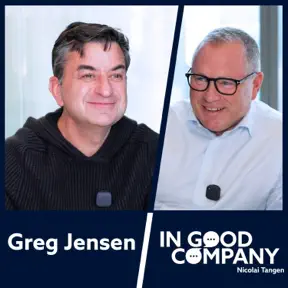
Greg Jensen: Building Bridgewater, mastering AI and the power of radical transparency
In Good Company with Nicolai Tangen
November 26, 2025
Greg Jensen, Co-CIO of Bridgewater Associates, joins Nicolai Tangen to discuss the forces reshaping global finance. They explore modern mercantilism, the AI resource grab for power and chips, and why talent competition matters.
Speakers Nicolai Tangen, Greg Jensen
TopicsBusiness
Nicolai Tangen (0:01)
Hi everybody, and welcome to In Good Company. And today, I'm here with Greg Jensen, who is the co-CIO of Bridgewater. Now, Bridgewater is just an incredible hedge fund, the world largest and best, I think we can say. And it's an honor to have you here, Greg.
Greg Jensen (0:18)
Thanks for having me.
Nicolai Tangen (0:28)
What are the most important things you are spending time on just now? What are you looking at?
Greg Jensen (0:34)
Yeah, if I said sort of the biggest level, the three big themes that I'm concerned about or focused on are A, the change in how the global and US economy is being managed. Essentially what we call a shift to modern mercantilism that's been a reaction to China's rise. It's created political changes across the West, probably most clearly in the US, leading to a whole different philosophy on how to run the economy. So that's one big theme, modern mercantilism, the way the US is operating both with respect to economics, but also with respect to geopolitical conditions. Huge change, really important to understand. The second is the technological change that we're in the midst of. I've been, as I'm sure we'll get into, thinking about and working with AI for a very long time, now machine learning for 15 years and more generally, my whole career, and I remember people used to say, Greg, why are you talking about AI all the time? Nobody says that anymore.
Nicolai Tangen (1:40)
It's nice to be right at the end, isn't it?
Greg Jensen (1:41)
Well, there's a lot of being wrong along the way, plenty to be wrong about. But that, it's so important, right? It's a third to half of everything, geopolitics, markets, everything, you have to understand it to understand the macro world. And third, that all is happening in a world where capital is more concentrated in the US than ever, more concentrated in equity and illiquid assets. So a kind of risky setup. So understanding where money has flowed to, why it's flowed there, and how likely that is to change. Those are the big three headlines.
Nicolai Tangen (2:17)
Well, let's unpack them one after the other. One of the implications for investors that we are moving towards mercantilism.
Greg Jensen (2:28)
Yeah, well, I think it's a big shift. If you're thinking the economy works the way it used to work, it's a really important change, right? If you take, there's a major change in the 1980s, a shift towards small government, a lot of capitalism, a lot of like kind of freedom of the private sector, to a very different view, right? That because China has risen, because you've hollowed out the middle class in a lot of the West, you've got a political reaction, takes different forms, but you've got a political reaction in the rest of the world. In Trumpian kind of mindset, the basic issues are, okay, you need the government to step in and stop what's been going on in terms of the neoliberal consensus on trade. You need this to basically protect US industry in order to be geopolitically strong. You can't be dependent on other countries, so you need to be independent, looking at trade as a zero-sum game, where if you have a trade deficit, that's actually a problem for your wealth.
And that that, along with other elements that come with more government control on these things, corruption and other things, have changed the way the game is being played. So for investors, you've got to adapt, right?
Nicolai Tangen (3:48)
But if I, 12 months ago, had told you what the world would look like now in terms of mercantilism, tariffs and so on, what would you have expected markets to have done?
Greg Jensen (4:01)
Yeah, well, if it's only one thing changing, right, you would think that this would have led to a bit of a shift away from the US. You would have thought that people would have taken down their massive risk concentration in the US because it's changing so quickly. You need more of a risk premium on those assets, and you're getting more like the US from an exceptional place to invest to a more normal place to invest.
Nicolai Tangen (4:22)
But it hasn't quite happened, right?
Greg Jensen (4:24)
Exactly, because it's not the only thing going on. If you look underneath the system, in one way it did, in the sense that if you look at US equities, for the first time since American exceptionalism really emerged post the global financial crisis the last 15 years, you've had the worst performance of US equities relative to the rest of the world equities in common currency terms that you've had over that 15-year period. So under the surface, you're seeing it. But the US is, of course, buffeted by the other big thing we talked about. AI is sucking up incredible amount of capital, and that's about to enter a new phase, we'll get to that.
64 more minutes of transcript below
Thousands of transcripts fetched by people building searchable podcast archives
Fetch the whole transcript
The demo key returns a sample episode in full, no card needed:
curl -H "x-api-key: pt_demo" \
  https://spoken.md/transcripts/1000651996090
Markdown with the speakers named, for your notes, your knowledge base, or anything that makes HTTP calls.
From $0.10 per transcript. No subscription. Credits never expire. Prices exclude VAT, added at checkout for EU customers. Not what you expected? Email us within 14 days with 20 or fewer credits used and we refund the pack in full.
Using your own key:
curl -H "x-api-key: YOUR_KEY" \
  https://spoken.md/transcripts/1000738547238