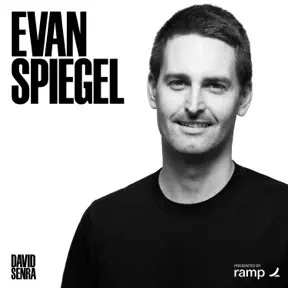
Evan Spiegel, Snap
David Senra
April 12, 2026
Evan Spiegel is the co-founder and CEO of Snap Inc., the company behind Snapchat. At Stanford, he enrolled in the product design program. In 2011, in a class project, he and two classmates — Reggie Brown and Bobby Murphy — sketched out the idea for an app where photos disappeared.
Speakers David Senra, Evan Spiegel
TopicsBusiness
David Senra (0:02)
I'm super excited to talk to you. We've been talking a bunch before we start reporting. I did a podcast on you like almost 10 years ago. It's episode 22 of Founders based on this book on how to turn down a billion dollars. The thing that stuck out to me the most when I read that book, because a lot of that story takes place when you're still in college, and you're talking about two of your entrepreneur heroes.
Steve Jobs, makes sense, my entrepreneur hero too. You mentioned this guy named Edwin Land. I'm reading this and I'm like, how the fuck does a 21-year-old kid even know who Edwin Land is? I've done like 10 podcasts on him, read every single biography. Tell me how you discovered Edwin Land and what you admired about him.
Evan Spiegel (0:38)
Yeah, I think he's so central to the history of photography. As we've set out to try to reinvent the camera and how people express themselves with the camera, we studied a lot about the evolution of the camera over time. One of the funny stories that we found out, the first selfie ever was taken by a guy named Robert Cornelius, and my co-founder Bobby, his name is Robert Cornelius Murphy. So we found just by unpacking the history of photography, a lot of interesting similarities and parallels. And we learned a ton from founders like Edwin Land who transformed photography really by focusing on building amazing products and thinking about how to make sure those products fit into people's lives and uplifted humanity. I think if you look at instant photography and the role that that played in people's lives, Edwin thought of the camera as something that was incredibly personal.
And I think as we've looked at the trajectory of technology, over the long arc of time, technology gets more and more and more and more personal. And so I think as technology gets more deeply interwoven in our lives, the founders who are thinking about making technology more personal and how the things they're inventing fit into and support humanity, I think that's a real advantage.
David Senra (1:49)
But how does a 21-year-old kid decide, because you even said it in the book, that you're like, I want to build a company at the intersection of technology and liberal arts. What was happening that you were interested in doing that?
Evan Spiegel (2:01)
Part of it was my background growing up. So I went to school in Santa Monica here, and a school called Crossroads. Crossroads, the full name for Crossroads is actually Crossroads School for Arts and Sciences. So it actually is the intersection of science and art together. And actually, a lot of what the school is focused on is developing empathy, building empathy. And they have this thing called council, for example, where you sit with about 12 other students and speak from the heart and take turns expressing yourself. And the school is really oriented on how you build strong relationships, build empathy with other people. And so, I grew up at a school that was so focused on the intersection of art and science, but then also wrapped all of it in a commitment to humanity, to understanding one another, to building relationships, to giving back. I mean, the school is very anchored in community service. Three of our kids go there now, which is fun. Some of the teachers are still there. But I think a lot of it was from my upbringing and that being a real focus. And then, as I got a bit older and I got into things like graphic design and I built my own computer, I was always sort of working at that intersection of art and technology.
David Senra (3:11)
Yeah, I think the perception of you is like you're like this cool, like, you know, designer. But you were actually self-described as like a nerd growing up.
Evan Spiegel (3:19)
My wife and I always joke, it's cool to be uncool. So, I definitely don't think of myself as cool. And my background really was, you know, in the computer lab. I mean, it's one of the things that also inspired a lot of the work that we do because as I reflect on growing up, one of my frustrations or disappointments with the way that computers have been built over time is that they actually pulled us away from one another. So, growing up, you know, during lunch, rather than being on the recess yard, running around with my friends, I was so inspired by what computers could do. I was obsessed with computers. So, I was in the computer lab all day long. And computers, I think, you know, whether it was the mainframe or the desktop, you know, have sort of pulled us away from one another, away from society, brought us indoors, right, into this very like single player experience. And so, a lot of what I've thought about and a lot of what has inspired me is like, how do we take all these extraordinary benefits that computing brings to the world, but actually use it to support our connections with one another, our connections to the world? Can we build a computer that brings us outside, right, that we use together with friends? Because I think, you know, one of the side effects of my love of technology growing up was that it pulled me away from, you know, more social relationships or just running around playing on the schoolyard.
121 more minutes of transcript below
Thousands of transcripts fetched by people building searchable podcast archives
Fetch the whole transcript
The demo key returns a sample episode in full, no card needed:
curl -H "x-api-key: pt_demo" \
  https://spoken.md/transcripts/1000651996090
Markdown with the speakers named, for your notes, your knowledge base, or anything that makes HTTP calls.
From $0.10 per transcript. No subscription. Credits never expire. Prices exclude VAT, added at checkout for EU customers. Not what you expected? Email us within 14 days with 20 or fewer credits used and we refund the pack in full.
Using your own key:
curl -H "x-api-key: YOUR_KEY" \
  https://spoken.md/transcripts/1000760911961